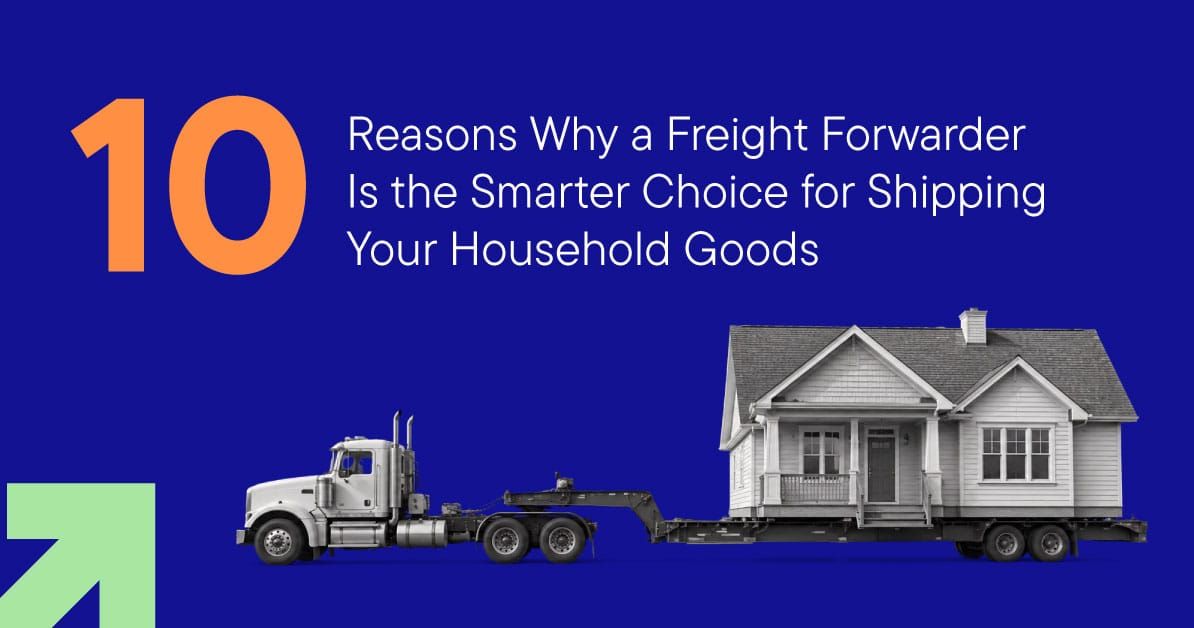
10 Reasons Why a Freight Forwarder Is the Smarter Choice for Shipping Your Household Goods
When it comes to shipping your household goods internationally, most people just Google shipping company and go with whoever comes up first.
Some end up with a logistics company. Some end up with a moving company. And then somewhere between their home and the destination port — things start going wrong.
The truth is not every company that moves cargo understands what it takes to move your personal belongings across borders.
An international freight forwarder is a very different animal from a logistics company — and that difference matters when your entire life is packed into a container on the ocean.
Here are 10 reasons why a freight forwarder is the smarter choice for your household goods.
1. A Freight Forwarder Knows Customs — A Logistics Company Just Moves Boxes
- A logistics company picks up your container and drops it at the port. That is where their job ends. A freight forwarder knows what happens after that.
- They understand CBP requirements, they know what documents are needed, and they know how to get your household goods through customs without a hold.
- When your container arrives at the US port, you need someone who speaks CBP's language — not someone who just drove the truck.
2. A Freight Forwarder Files Your Customs Documents — A Logistics Company Does Not
- CBP Form 3299. Bill of Lading. Packing list. Inventory declaration. These are not optional — they are required for every household goods shipment entering the USA.
- A logistics company has no responsibility for any of this. A freight forwarder handles every document, reviews every form, and files everything correctly before your shipment arrives.
- One missing document can hold your entire container. A freight forwarder makes sure that never happens.
3. A Freight Forwarder Tells You What Cannot Go in the Container
- Nobody wants to find out at the US port that something in their container is restricted. A freight forwarder reviews your full packing list before anything is loaded and flags every item that could cause a CBP problem.
- Plants, certain foods, hazardous materials, protected animal products — a freight forwarder catches these before they become a port nightmare. A logistics company loads what you give them and asks no questions.
4. A Freight Forwarder Gets You the Best Freight Rate
- A freight forwarder works with multiple shipping lines and carriers. They compare rates, negotiate on your behalf, and find you the most cost effective option for your specific volume and destination.
- A logistics company works with whoever they have a contract with — and that rate is what you pay. If you are moving your household goods internationally, a freight forwarder almost always finds you a better deal.
5. A Freight Forwarder Handles Both Origin and Destination
- A logistics company handles their end. A freight forwarder manages both ends of your move — the pickup in your home country and the delivery to your new address in the USA.
- One point of contact. One team with full visibility of your shipment from door to door. When something goes wrong mid transit — and sometimes it does — there is one person accountable for fixing it instead of two companies pointing at each other.

6. A Freight Forwarder Knows the Duty You Owe Before You Ship
- Duties on household goods are real — and they can be significant. A freight forwarder reviews your inventory, classifies your items correctly under the right HTS codes, and gives you an accurate duty estimate before your shipment moves.
- No surprises at the port. A logistics company has no visibility on your duty liability. You find out what you owe when CBP hands you the bill — by which point your container is already at the port collecting storage charges.
7. A Freight Forwarder Manages Your Shipment If Something Goes Wrong
- Your container gets held at customs. CBP wants additional documentation. A restricted item was found in the shipment.
- A logistics company has no role in any of this — their job was moving the box, not clearing it.
- A freight forwarder steps in immediately, communicates with CBP on your behalf, provides the required documentation, and works to get your goods released as fast as possible. This is the difference that matters most when things do not go to plan.
8. A Freight Forwarder Arranges Cargo Insurance for Your Household Goods
- Your household goods are travelling thousands of miles across an ocean. Containers get damaged. Cargo shifts. Things break.
- A freight forwarder arranges proper cargo insurance covering the full replacement value of your goods before your shipment moves.
- A logistics company is not responsible for what happens to your goods in transit — and their liability is typically limited to a fraction of your actual loss.
- Without proper insurance, a damaged shipment is a financial loss with no recourse.
9. A Freight Forwarder Gives You Real Time Visibility on Your Shipment
- When your entire life is packed into a container on the ocean, you want to know where it is.
- A freight forwarder tracks your shipment throughout the journey and keeps you updated at every stage — departure, transit, arrival, customs clearance, and delivery.0
- A logistics company moves cargo — they are not set up to give you the kind of personal shipment visibility that matters when you are waiting for your household goods to arrive at your new home.
10. A Freight Forwarder Has Done This Before — Many Times
- Experience is everything in international shipping. A freight forwarder who has moved thousands of household goods shipments has seen every situation — every customs hold, every documentation issue, every restricted item, every port delay.
- They know how to handle it because they have handled it before. A logistics company that moves general cargo is not the same as a freight forwarder who specialises in getting household goods across borders. When your personal belongings are on the line, experience is not something you want to compromise on.
Air 7 Seas has been moving household goods internationally for over 40+ years. Here is what that means in practice:
- 40+ years of international freight forwarding experience
- 150+ countries served — we move household goods from anywhere to anywhere
- Licensed US Customs Broker — we handle CBP clearance on every shipment
- 1 million+ cargo movements handled across our lifetime
- 100+ certified freight professionals managing your shipment at every stage
- A rated cargo insurance covering the full replacement value of your goods
- Dedicated point of contact for every household goods shipment from door to door
- FMC licensed NVOCC — meaning we operate our own ocean freight contracts giving you better rates than most
The families who get through an international move without the stress are not the lucky ones. They are the ones who chose the right partner before the container was packed.
Frequently Asked Questions
1. What is the difference between a freight forwarder and a logistics company?
A logistics company picks up your goods and moves them to the port — that is where their job ends. A freight forwarder manages everything including customs clearance, documentation, duty calculation, and delivery to your new home.
2. Do I need a freight forwarder to ship my household goods to the USA?
You do not legally need one, but without a freight forwarder you are responsible for handling all CBP documentation, customs clearance, and duty payments yourself — which is where most people run into serious problems.
3. What documents does CBP require for household goods entering the USA?
CBP requires a Bill of Lading, detailed packing list, and inventory declaration at minimum. Missing even one document can hold your entire container at the port.
4. Will I have to pay duties on my household goods when moving to the USA?
It depends on your items and eligibility. A freight forwarder reviews your full inventory, classifies each item correctly, and gives you an accurate duty estimate before your shipment moves — so there are no surprises at the port.
5. What happens if something in my container is restricted by CBP?
CBP can hold your entire container if a restricted item is found. A freight forwarder reviews your packing list before loading and flags any restricted items — plants, certain foods, hazardous materials — before they become a port problem.
6. Is my cargo insured when shipping household goods internationally?
Not automatically. A freight forwarder arranges proper cargo insurance covering the full replacement value of your goods. Without it, the shipping line's liability is typically limited to a very small fraction of your actual loss.
7. How long does it take to ship household goods to the USA?
Transit time depends on origin country and shipping route, but ocean freight typically takes 2 to 8 weeks. A freight forwarder gives you real time tracking and updates at every stage — departure, transit, customs clearance, and final delivery.