What Is a Bill of Lading? A Complete Guide for First-Time Shippers
Your freight forwarder has probably said "Bill of Lading" a few times already — maybe more than a few. And if you're still not sure what it actually means, you're not alone.
As a first-time importer bringing goods into the USA, this is one term you'll want real clarity on, because you're going to hear it throughout your entire shipment — from booking to delivery.
So in this blog, we'll break it down in simple terms, so that you know exactly what it is and why it matters every step of the way.
What Is a Bill of Lading?
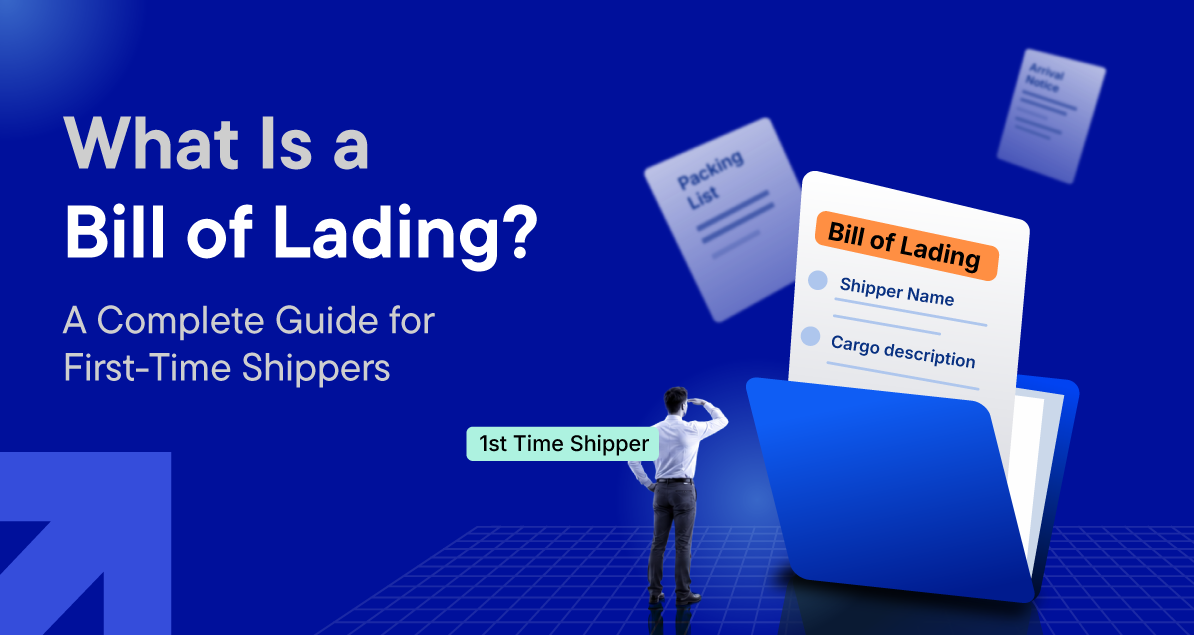
A Bill of Lading (often shortened to BOL or B/L) is a document your shipping company or freight forwarder gives you once your cargo is loaded for transport. Think of it as three things in one:
- A receipt — proof that your goods were picked up and loaded onto the ship
- A contract — an agreement between you and the carrier about how and where your goods will be transported
- Proof of ownership — the document that shows who's legally allowed to claim the shipment at the other end
Without it, your shipment technically has no proof of who it belongs to or where it's supposed to go. That's why it comes up so often throughout your shipment — nearly every step, from pickup to delivery, ties back to this one document.
Example: Say you're shipping a container of furniture from the USA to India. Once the container is loaded onto the ship, the carrier issues a Bill of Lading with your name (or your consignee's name) on it, the description of the goods, and the destination port. When the container reaches India, whoever holds that Bill of Lading — you, your consignee, or your customs broker acting on your behalf — is the only one legally allowed to claim the shipment. No Bill of Lading, no release. Even if the goods are clearly yours, the carrier won't hand them over without it.
And if your shipment gets held up for any reason — a customs issue, a documentation mismatch, anything — the carrier will only communicate with the person or company named on the Bill of Lading. If you're not on it, you can't step in and sort things out directly. That's one more reason it's worth knowing exactly who's listed before your shipment even leaves port.
What Does a Bill of Lading Actually Do?
A Bill of Lading serves three specific purposes, and it's worth understanding each one separately, since they matter at different points in your shipment.
1. It's a receipt of goods. The moment your cargo is loaded, the carrier confirms — in writing — exactly what was received, how much, and in what condition. If there's ever a dispute about what was shipped, this is the document both sides point back to.
2. It's a contract of carriage. This spells out the terms between you and the carrier: where the goods are going, how they'll be transported, and what the carrier is responsible for along the way. It's the legal agreement behind the shipment, not just a shipping label.
3. It's a document of title. This is the part people underestimate most. Whoever legally holds the Bill of Lading has the right to claim the shipment at the destination. It's not just proof you shipped something — it's proof of who owns it right now.
Most first-time importers only think of it as paperwork. In reality, it's the document doing all the legal heavy lifting behind your shipment.
Types of Bills of Lading
There are several types of Bills of Lading out there, but as a first-time importer, the two that matter most — and the ones you'll actually deal with — are the Master Bill of Lading and the House Bill of Lading.
Master Bill of Lading
This is issued by the actual carrier (the shipping line that owns the vessel), directly to your freight forwarder. It covers the shipment at the carrier level and lists the forwarder as the party responsible for the cargo, not you directly.
House Bill of Lading
This is issued by your freight forwarder to you, the actual shipper. It's the document you'll personally deal with, and it reflects the specific terms your forwarder agreed to with you — even though the cargo is moving under the Master Bill of Lading behind the scenes.
Here's why the distinction matters: if there's ever an issue with your shipment, your direct point of contact is whoever issued your House Bill of Lading — usually your forwarder. They deal with the carrier on the Master Bill of Lading on your behalf, so you're not left trying to resolve things directly with the shipping line yourself.
What Happens If There's a Mistake on Your Bill of Lading
Even a small error on a Bill of Lading can cause real delays. A misspelled name, a wrong consignee, or missing details about the cargo can mean the carrier won't release your shipment until it's corrected — and corrections aren't instant.
A few common issues:
- Wrong consignee name. If the name doesn't match the ID of the person picking up the shipment, the carrier won't release it. This is especially common in household moves where a family member picks up the shipment instead of the person who booked it.
- Missing or incorrect cargo description. If what's on the Bill of Lading doesn't match what's actually in the shipment, customs can flag it for inspection — adding days to your timeline.
- Lost Bill of Lading. Since this document proves ownership, losing it isn't like losing a receipt. Depending on the type, you may need a formal indemnity process before the shipment can be released.
The safest approach: double-check every detail on your Bill of Lading — your name, the cargo description, the destination — before your shipment leaves port, not after.
How to Get a Bill of Lading
You don't request a Bill of Lading directly from the carrier yourself in most cases — your freight forwarder handles this as part of booking your shipment. Here's how it usually works:
- You book your shipment with your forwarder and provide the shipment details (what's being shipped, where it's going, who's receiving it).
- Once your cargo is loaded onto the vessel, the carrier issues a Master Bill of Lading to your forwarder.
- Your forwarder then issues you a House Bill of Lading, which reflects your specific shipment and terms.
- You'll typically receive a copy shortly after your cargo is loaded — not before, since it confirms goods were actually received onto the vessel.
If you're working with a customs broker or forwarder who handles this in-house, this process tends to move faster and with fewer handoffs, since the same company is managing both the shipping and the paperwork.
Here's the good news: you don't have to figure this out on your own.
With AIR7SEAS, this moves even faster, since the same company handling your shipment also handles your customs paperwork in-house. That means one point of contact, not two — and one less thing for you to manage on your own.
Frequently Asked Questions
Do I need a Bill of Lading for every shipment?
Yes. It's a required document for any ocean freight shipment — there's no way to legally move or claim cargo without one.
Can I ship without a Bill of Lading?
No. Carriers won't load or release cargo without one, since it's the document that proves ownership and outlines the terms of transport.
What's the difference between a Master Bill of Lading and a House Bill of Lading?
A Master Bill of Lading is issued by the carrier to your freight forwarder. A House Bill of Lading is issued by your forwarder to you. Both cover the same shipment, but represent two different legal relationships in the chain.
What happens if I lose my Bill of Lading?
Depending on the type, you may need to go through a formal indemnity process with the carrier before your shipment can be released — it's not as simple as reprinting a lost receipt.
Who should be named on the Bill of Lading?
Whoever you want to be able to claim the shipment or communicate directly with the carrier if something comes up — for household moves, this is usually the person booking the shipment or their designated consignee.